Foocus background - Two football players competing for the ball during a match

Case Study

Foocus

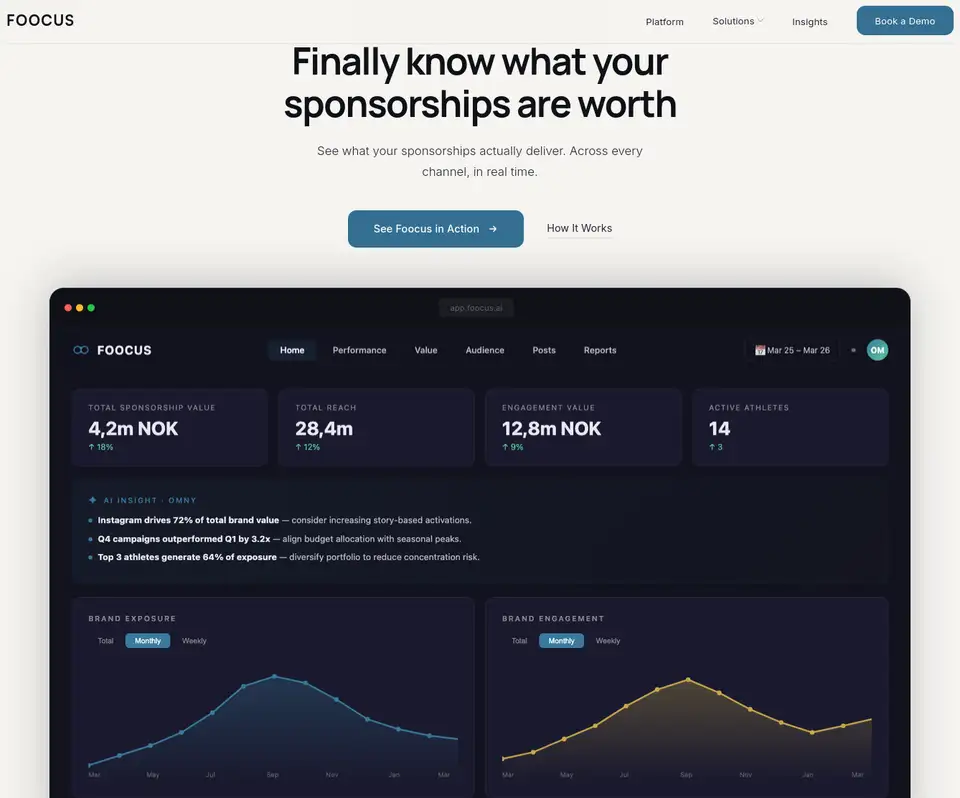
Foocus is a company providing brand exposure and engagement insights.

Foocus website showing a sponsorship value and brand exposure analytics dashboard

Overview

Foocus helps customers understand how brands appear across broadcast footage, event recordings, and social media. Their platform depends on reliably detecting brand logos in uploaded image/video, tracking them across frames, and converting detections into measurable exposure insights

The Challenge

Logo detection in sports video is difficult because logos appear under highly variable real-world conditions: on jerseys, signage, and equipment; across different camera angles and lighting; and often partially occluded, distorted, or visible only briefly. Training a reliable model requires ton of currated annotated data.

Our task was to create a pipeline that eases process of annotation and model training, reducing time that customer waits for first exposure insights.

Our Solution

profiq provided Foocus with dataset gathering, annotation and model training, gradually improving the process. We designed scalable AI pipelines for data augmentation, training and finetuning and iterative process for dataset annotation and curation.

Project approach

1

Efficient dataset and annotation workflow

We helped establish an iterative model training loop: annotate a focused sample, train an initial baseline model, use it to pre-annotate additional data, then selectively add harder and more informative examples. This improved annotation efficiency while also making it easier to target the scenarios that mattered most for production performance.

The workflow also evolved from using Roboflow platform for everything toward a more scalable tooling stack using CVAT for annotation and FiftyOne for dataset management, filtering, and export control.

2

Training and improving logo detection models

Foocus required multiple specialized models for different brands, sports, and customer use cases. profiq worked across dataset preparation, augmentation, training, evaluation, and iterative model improvement.

A key practical takeaway was that augmentation helped, but real production data remained essential. Synthetic or augmented samples improved results only when combined with a strong base of real labeled imagery.

3

Advanced approaches with practical value

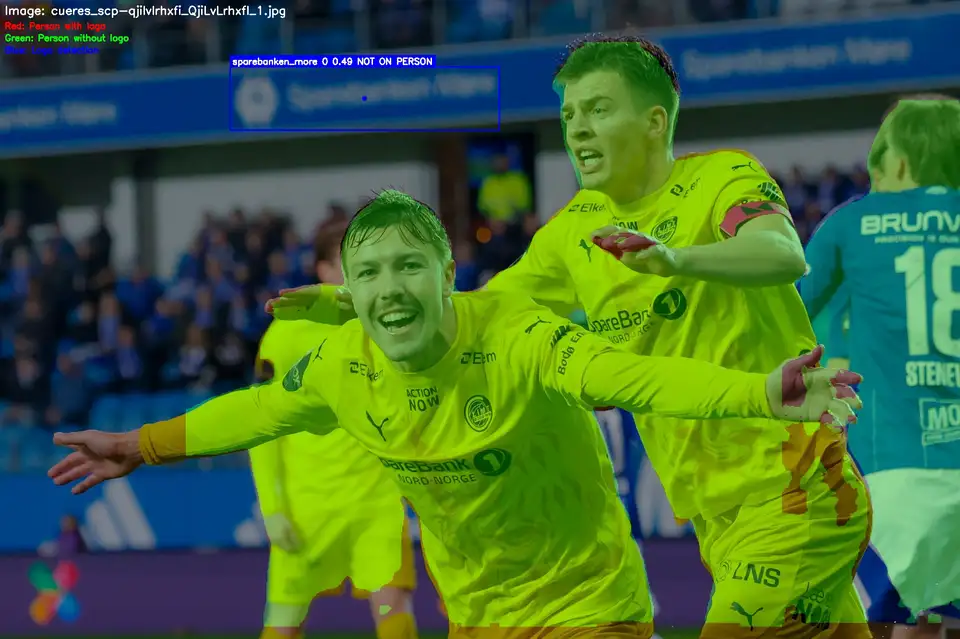
The engagement also included evaluating which emerging AI techniques could create real value in production. Segmentation-based logo placement analysis distinguished whether a detected logo appeared on a person, such as a jersey, or in the surrounding scene, such as signage. A general logo detector based on SAM3 plus a specific classifier pipeline created a faster path for onboarding new customers with fewer labeled examples. Additional experiments included synthetic data generation in Blender, novel visual backbones (DINOv2 and DINOv3), and vision-language models (Qwen2.5-VL).

4

Production support

In addition to research and model training, profiq took care of running production inference workflows and helped consolidate training-related scripts and processes, making the overall system easier to maintain and improve over time. On-demand basis, we also provided help with software development, extending the customer facing app.

Technologies and Tools

The solution combined practical ML engineering with modern computer vision tooling, including Python-based training and inference workflows, YOLO-style detection pipelines, Albumentations, Roboflow, CVAT, FiftyOne, Modal, Transformers and Qwen2.5-VL for vision-language experiments, DINO-based classification experiments, SAM3, segmentation workflows, and supporting backend systems.

  • Python icon
  • YOLO icon
  • Albumentations icon
  • Roboflow icon
  • CVAT icon
  • FiftyOne icon
  • Modal icon
  • Transformers icon
  • Qwen2.5-VL icon
  • DINO
  • SAM3
  • Segmentation

Benefits

Repeatable workflow

An iterative workflow for training and improving logo detection models.

AI methodology

Clearer guidance on which advanced AI methods were worth adopting in production.

Dataset curation

Pre-annotation and targeted dataset curation reduced manual effort.

Maintainability

Consolidated scripts and tooling made the system easier to evolve.

Conclusion

Foocus needed more than training models. They needed an adaptable AI workflow capable of supporting a fast on-boarding of new customers.

profiq helped build that capability end to end: preparing datasets, designing annotation workflows, training and evaluating models, supporting production inference, and testing advanced approaches where they could deliver measurable value.

The result was a practical AI pipeline for iterative model training, ready for continued improvement.

Football players segmented by whether detected sponsor logos appear on them
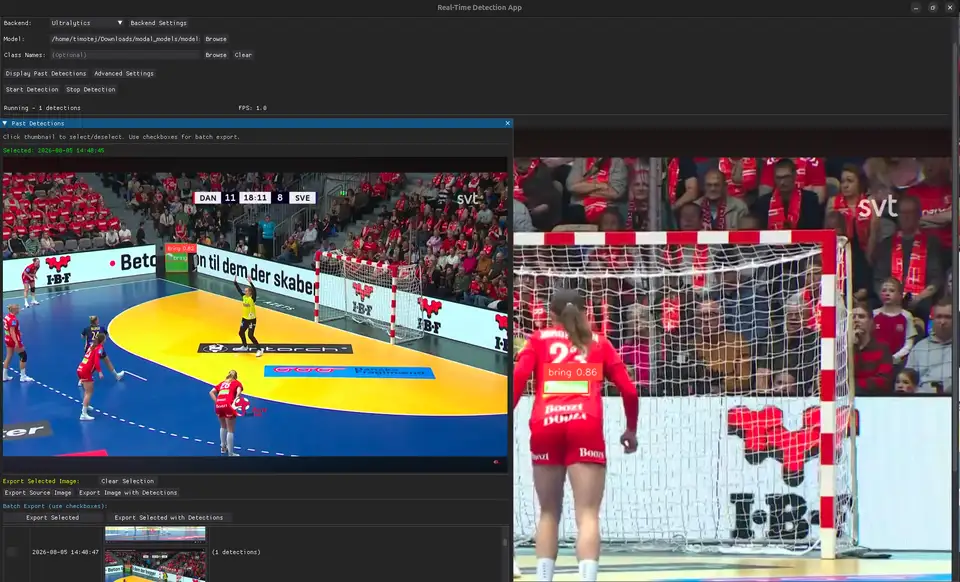
Real-time detection app identifying sponsor logos in a handball broadcast
Football players segmented for logo placement analysis with a background sign detected separately

Thank you for reading

Wanna talk? Please, get in touch

I agree to the processing of personal data by clicking on the Submit button.