




Risk-Free trial

Blog

This blog is intended for software system engineers, architects and managers or people generally interested in development, testing and integration of software systems. It is part of profiq’s community effort that has the objective of sharing knowledge and ideas about software system integration, testing and development. In addition to this technical content, we share updates about life at profiq.

Tags

Beyond Vibe Coding: When Fast Prototypes Meet Production Reality

There has never been a better time to build software. Today, you can describe an idea to AI and have a working application before lunch. That's an incredible shift, and it's exactly why "vibe coding" has become part of the engineering conversation. For prototypes, internal tools, and validating ideas, it's one of the most exciting developments we've seen. At profiq, we use AI every day. We believe it fundamentally changes how software gets built. But after spending the last year building Weaver, our AI-assisted development platform, we've learned something important.…

Is The Most Valuable AI Function Asking Better Questions?

How the "Grill Me" method became a key part of Project Weaver's approach to AI-assisted software development. In previous articles, we've shared some of the thinking behind Project Weaver—the internal engineering framework we've developed at profiq to help our teams and AI work together more effectively. Rather than treating AI as a magic code generator, Weaver is built around a simple idea: the better the structure, context, and engineering discipline, the better the outcomes. One of the influences behind our latest addition comes from the wider engineering community. The original…

From Vibe-Coded Prototype to Production-Ready App Using Weaver

One of the most interesting things about the current wave of AI-powered software development is that it has dramatically lowered the barrier to creating a working prototype. That's a good thing. Founders can validate ideas faster, test assumptions earlier, and communicate product concepts in ways that would have required significant engineering investment just a few years ago. But there's an important distinction between a prototype that demonstrates an idea and a system that can support a real business. Recently, we had the opportunity to explore that distinction firsthand while working…

Quick Recap: Project Weaver Engineering Series

At profiq, Project Weaver started as an internal experiment: could AI help professional engineering teams build serious, scalable backend systems faster without sacrificing architecture, security, maintainability, or engineering discipline? What followed became an evolving public engineering journal exploring planning, specifications, documentation, workflows, automation, and the changing role of engineers in the age of AI. It’s been about 5 months since our last recap of the Weaver journey, so we thought it was time to check in again to document the first idea through the latest automation and workflow experiments.  1.…

Annotation Is the Bottleneck — Here’s How We Fixed It

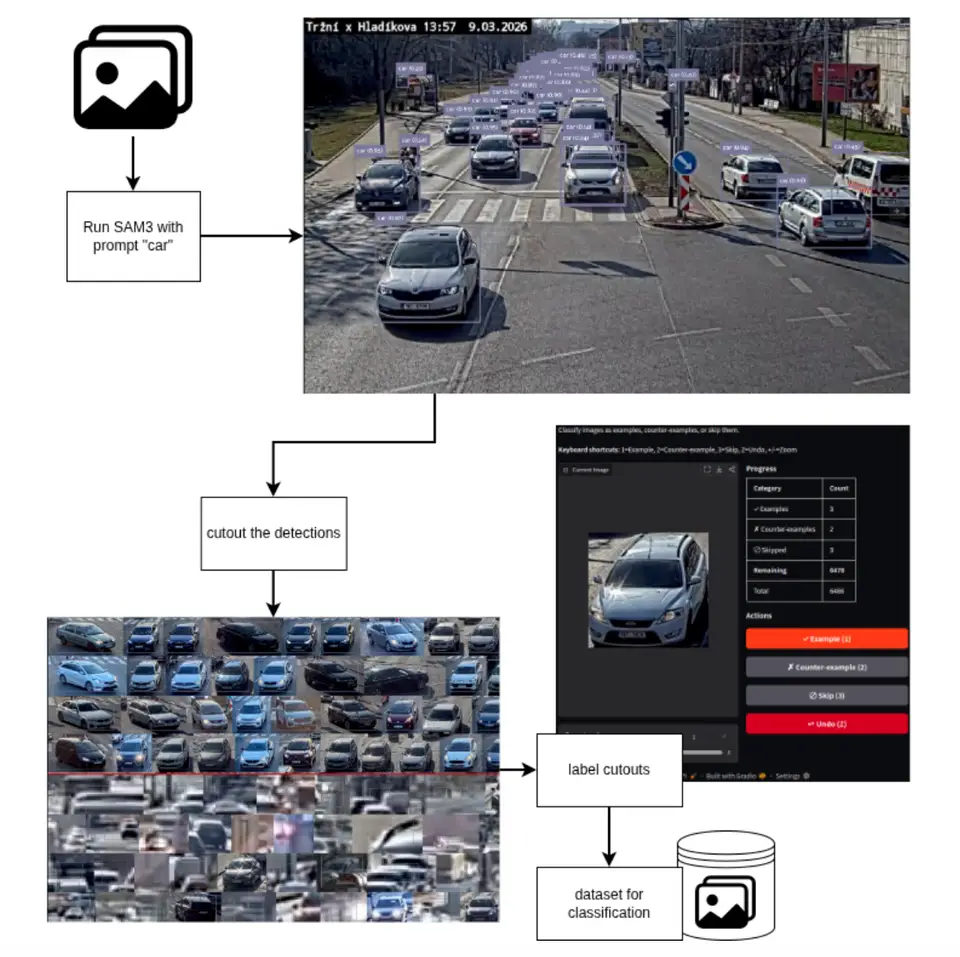
Towards auto-annotation pipeline for object detection models By Timotej Ponek To train any computer vision model (CV) model for a specific task, you first need to have (relevant) data. The second thing is to annotate and curate this data. You need high-quality annotation, meaning precise bounding boxes and for individual samples to be varying, so your model is trained to generalize well to unseen data (data not present in training). Gathering the data can take hours, and annotating takes days. Standard workflow At profiq we have experience with end-to-end CV…

The Age of Bespoke Applications: The Weaver Engineering Series

We’re entering a new era of software. For years companies had two choices: buy expensive SaaS tools or build large custom systems that took months or years to deliver. Today, AI-assisted development and modern frameworks are changing that equation. Need a custom CRM tailored to your sales process? Need internal tools that automate workflows across teams? Need systems that integrate multiple services without the bloat of dozens of SaaS licenses? All of this is now possible, faster than ever. At profiq, we’ve been exploring how to build software responsibly and…

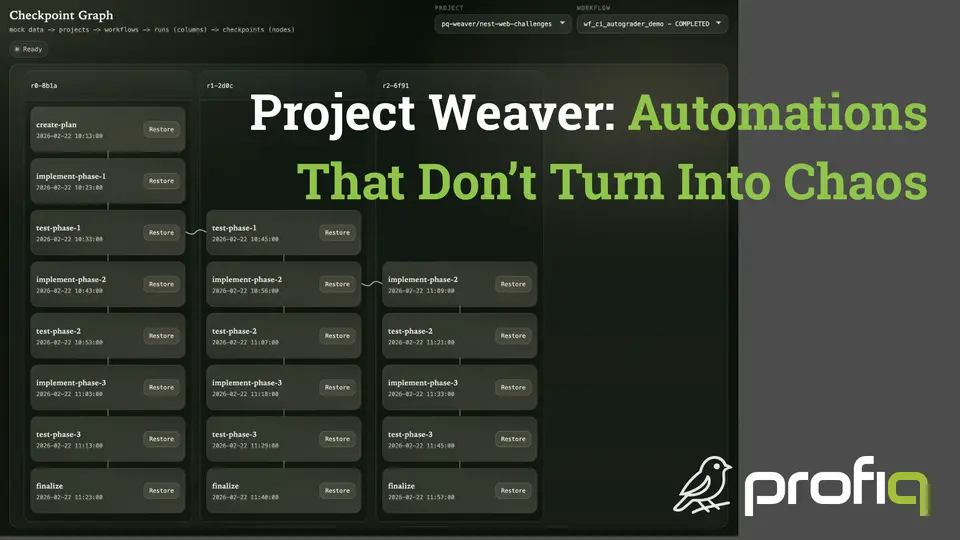
Project Weaver: Automations That Don’t Turn Into Chaos

When we talk about “AI-assisted development,” it’s easy to picture someone prompting a coding agent on their laptop and watching it produce a pull request. That workflow can already be useful. You get speed, you get momentum, and you can keep a human in the loop at every step. But in Project Weaver, that’s not the end goal. That’s the starting point. The goal of our Phase 2 work has been to take the good practices we’ve been writing about, and make them repeatable: Working from documentation and specs Using…

Feedback Loops: What Makes AI Coding Agents Actually Useful

In the last couple of posts, we talked about planning and documentation as foundations of reliable AI-assisted development. Planning gives you direction. Documentation gives both humans and agents a shared understanding of what “done” actually means. But once those are in place, something else becomes critical. Feedback. Not as a refinement step. Not as polish. As the thing that makes an agent an agent. Without feedback, an AI model just produces output. It generates code and stops. With feedback, it can act, observe what happened, and adjust. That ability to…

Documentation – the Next Priority in AI-Assisted Development

In our last blog article, we talked about Workflow Planning as the most important step in reminded, reliable AI-assisted software delivery. Planning creates alignment, reduces rework, and gives both humans and agents a shared map of what “done” actually means. But once planning is solid, the next priority is: Documentation. Not as a nice-to-have. Not as a compliance checkbox. As a practical way to make coding agents more accurate, more consistent, and far less likely to drift into outdated assumptions. This post explains why documentation matters so much for AI…

From “Just Let It Code” to “Build a Plan”: The Weaver Workflow

In the early days of AI coding tools, the vibe was simple: point the model at a problem and let it generate code. That worked… sometimes. Mostly on small things. Mostly when you were lucky. But as Viktor Nawrath (who leads Project Weaver at profiq) emphasized: the tooling is moving so fast that “last month’s information is already too old.” The models aren’t always making huge leaps every release, but everything around them is compounding fast: agent harnesses, tool integrations, workflows, and how we actually “drive” agents responsibly. That’s where…