








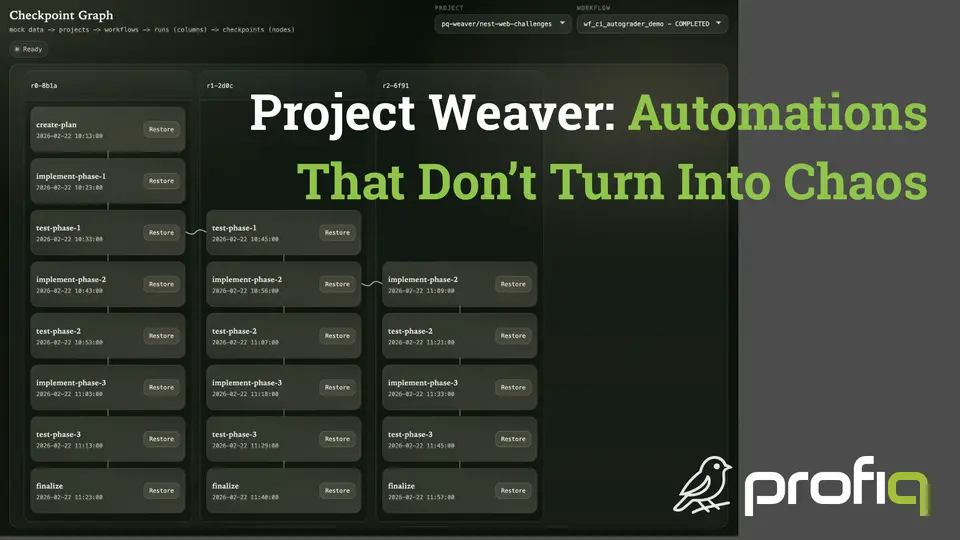
Project Weaver: Automations That Don’t Turn Into Chaos

Anke Corbin
10 min read
There are two ways we’ve explored automating Weaver so far. The first is the obvious one: use GitHub Actions and the second Temporal for Time Travel.
10 min read
There are two ways we’ve explored automating Weaver so far. The first is the obvious one: use GitHub Actions and the second Temporal for Time Travel.
8 min read
In the last couple of posts, we talked about planning and documentation as foundations of reliable AI-assisted development.
10 min read
Why a key AI development capability is workflow planning: the ability for an agent to take a problem, ask the right questions, propose implementation steps, and only then move into execution.
6 min read
We’ve been building in public — documenting our thinking, sharing what we’ve learned, and inviting the community into a conversation about the future of AI-augmented software development.
8 min read
Project Weaver is answering the question: What does it take for an AI system to operate as a genuine engineering partner- not a code autocomplete, but a collaborator that can meaningfully participate in the creation of real backend applications?
6 min read
When we started Project Weaver, we weren’t trying to build another AI coding assistant.
5 min read
At profiq, we've always believed that the best engineering work grows from curiosity, collaboration, and honest reflection. That is why we've decided to build in public.
5 min read
Over the past year, AI-powered development has shifted from curiosity to inevitability.

12 min read
Testing is crucial for producing reliable software.
3 min read
Qwik introduces novel architecture that eliminates the need for the traditional UI hydration process, a step that often bogs down web apps with unnecessary overhead. Watch the demo video for Qwik.
Try another category, tag, or search term.